A server called atom
24 Nov 2026For 16 years, I had a server called atom.
Cattle vs pets
We’ve shifted the paradigm of servers from caring about a given server to managing them at scale, often as ephemeral entities somewhere in the cloud, not in your closet. Nowadays, servers are more like cattle, not pets. I like this analogy by Randy Bias. If it is in the cloud, you’re likely using autoscaling, and the machine doesn’t even have a proper name. If you use Terraform or CloudFormation, you don’t care about machines either. Provisioning tools like Ansible or Chef require you to have a name or a group of machines. Even for them, I tend to call machines app01, db01 and so on to simplify operations.
An entirely different thing is your home machines. They are pets, unless you have a server farm at home. You don’t usually care about your laptop’s name since you access it physically, not over the network. But the home server desperately needs a proper name, not some generic Dell-Server-R810-V2. You connect to it in different ways — file sharing, media access, SSH, home automation.
Atomic epoch
My first server from 2009 was called atom. The reason is simple — it was an Intel Atom CPU. It was a strange but interesting processor family. It was still x86 (even x86_64), but in a very classical architecture with in-order execution. In 2008, the famous Nehalem microarchitecture was introduced, powering the new Intel Core i7. NetBurst was finally gone, and AMD was already on Phenom. Those were exciting times.
I got the second iteration of the Atom family — Intel Atom 330, a low-power dual-core Diamondville processor built on 45 nm Bonnell microarchitecture with a very low TDP of 8 W. It had reasonable performance with 64-bit support, Hyper-Threading, and SSE3.
So it was packed with an Intel D945GCLF2 motherboard, two RAM sticks, a 5400 rpm Seagate HDD, and a lovely Morex 2755 mini-ITX chassis. It was really small, like an A4 sheet of paper, and 60 mm thick. It had only one small fan on the side, and it was enough to cool down a low-power CPU and a slow HDD.
The server stayed in the same room with me in the first house, because I didn’t have a server room. So I wanted the server to be small and quiet. After I replaced the fan with an advanced one with better bearings, this design fulfilled my needs.
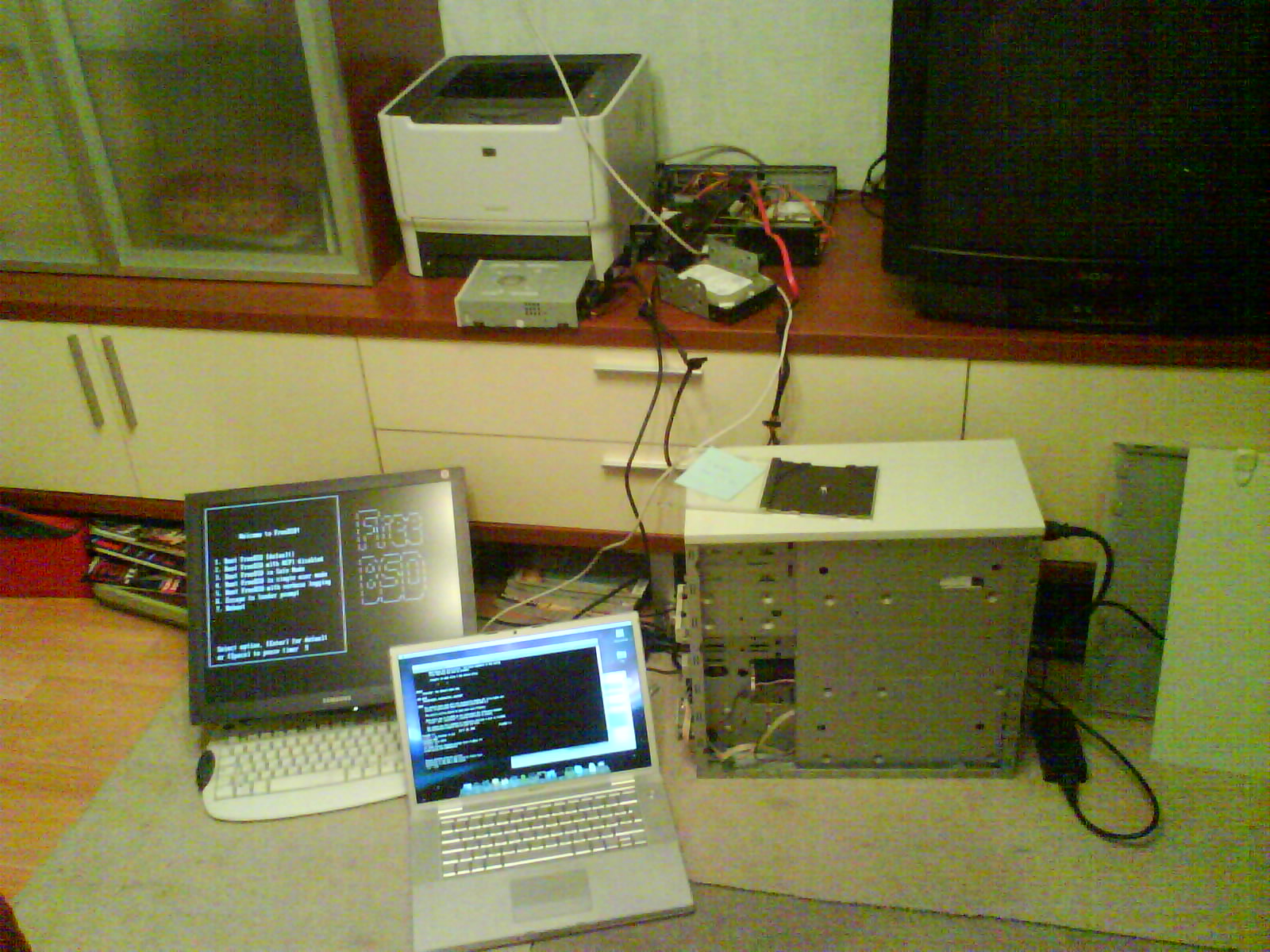
I installed FreeBSD on it and tinkered with it for a few months. In February 2010, I decided to go with Debian, which had been around for 16 years.
The atomic server was ready.
I had plenty of computers around with Linux, Mac OS X, Windows, and FreeBSD, connected by different protocols — SSH, WebDAV, AFP, NFS, SMB, HTTPS. Of course, you need name resolution, so DNS was essential. And you will see hostnames a lot. The server had a proper name, atom. I started calling the rest of the homelab particle physics: baryon, muon, tau, gluon, quark. At some of my jobs, we named all our servers consistently using stars in constellations. Sometimes, it was harder to understand, but that was a brilliant chance to educate engineers on astronomy. Now we can learn particle physics at home.
It was a full-fledged Debian machine always nearby, even via SSH or web when I was travelling. It powered home automation, media playback, music collection, backups, and a lot of my own services. It was a time when I was developing and deploying many new projects, learning new things on real hardware.
Atom Rebuilt
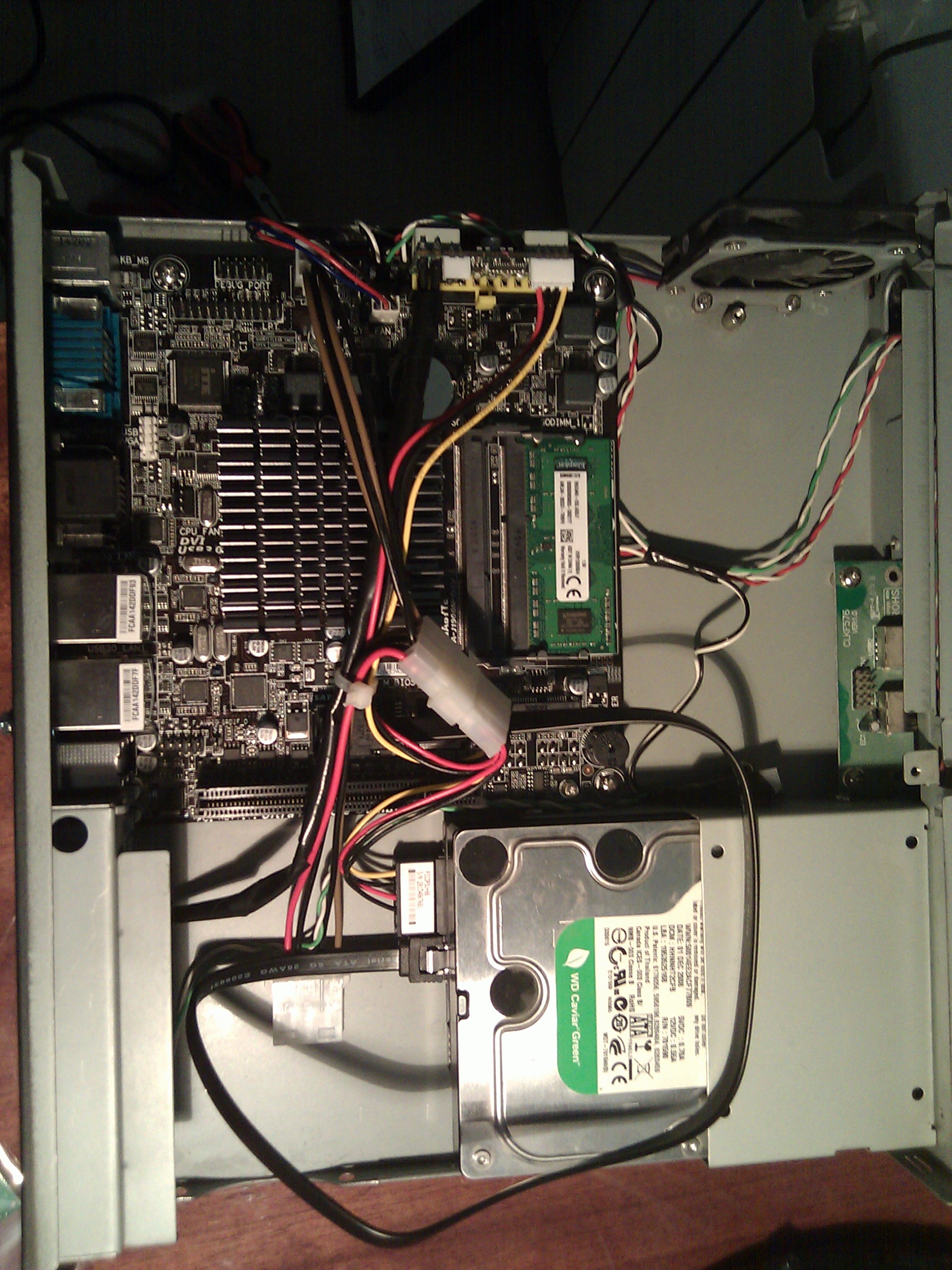
In 2015, I rebuilt it with an Intel Celeron J1900, which is a Bay Trail-D processor built on the 22-nm Silvermont microarchitecture. It is still an Atom processor. Hence, the name stayed. I had to switch to a Gigabyte J1900N-D3V motherboard because it used a different socket. It stayed low-power (under 10 W) but was faster, with SSE4 and Intel Virtualisation aka VT-x.
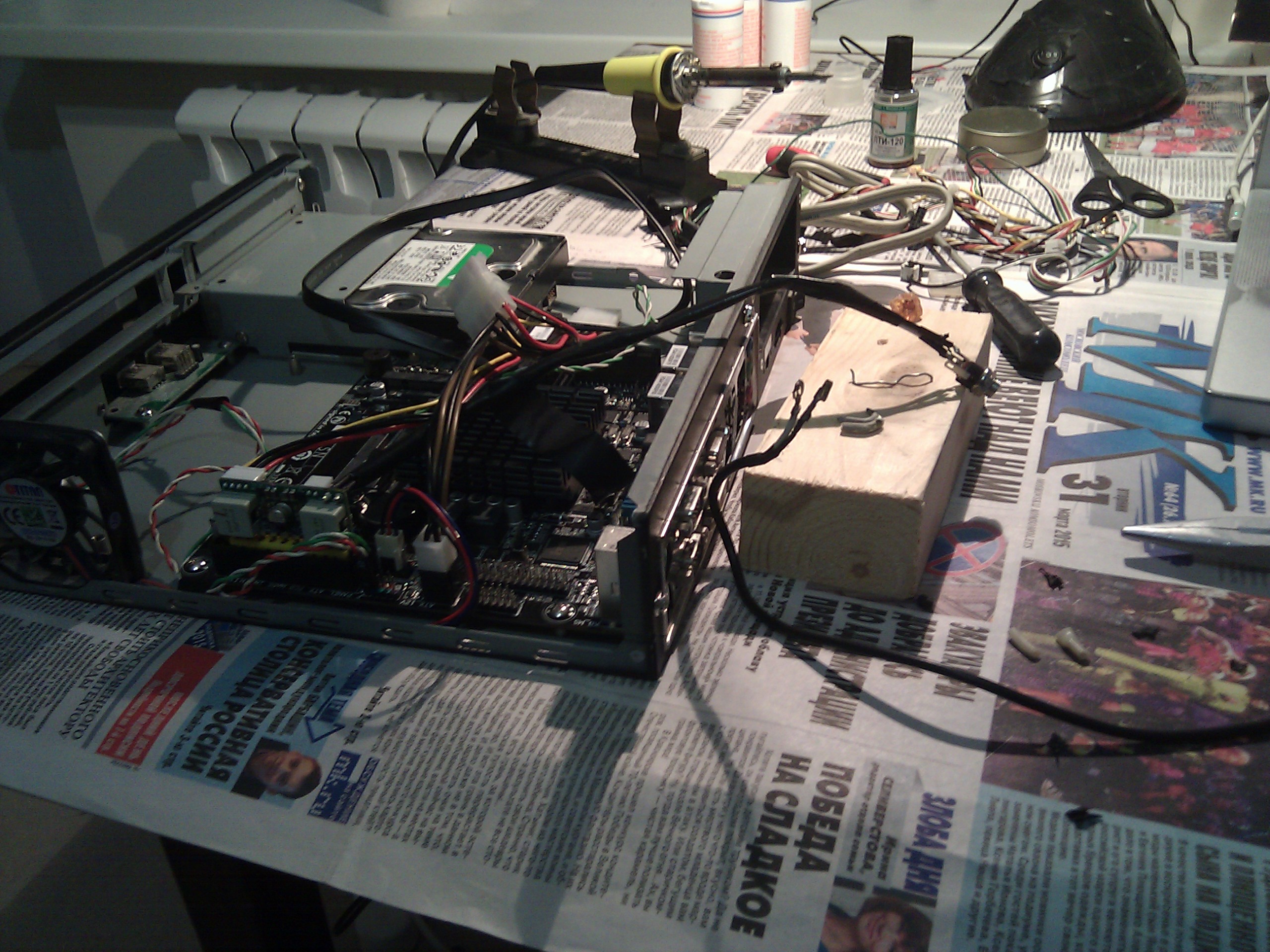
Unfortunately, my old Mini-ITX case couldn’t fit the motherboard properly. Some cables were not long enough to reach the ITX power connectors. So I literally resoldered new connectors so they could do the job. If you saw stock photos of someone poking a motherboard with a soldering iron, it was me.
This server ran for a very long time. Powered by a good UPS, the server could power off gracefully on a USB signal when the battery charge dropped below 50%, so the hardware stayed intact and didn’t experience abrupt shutdowns.
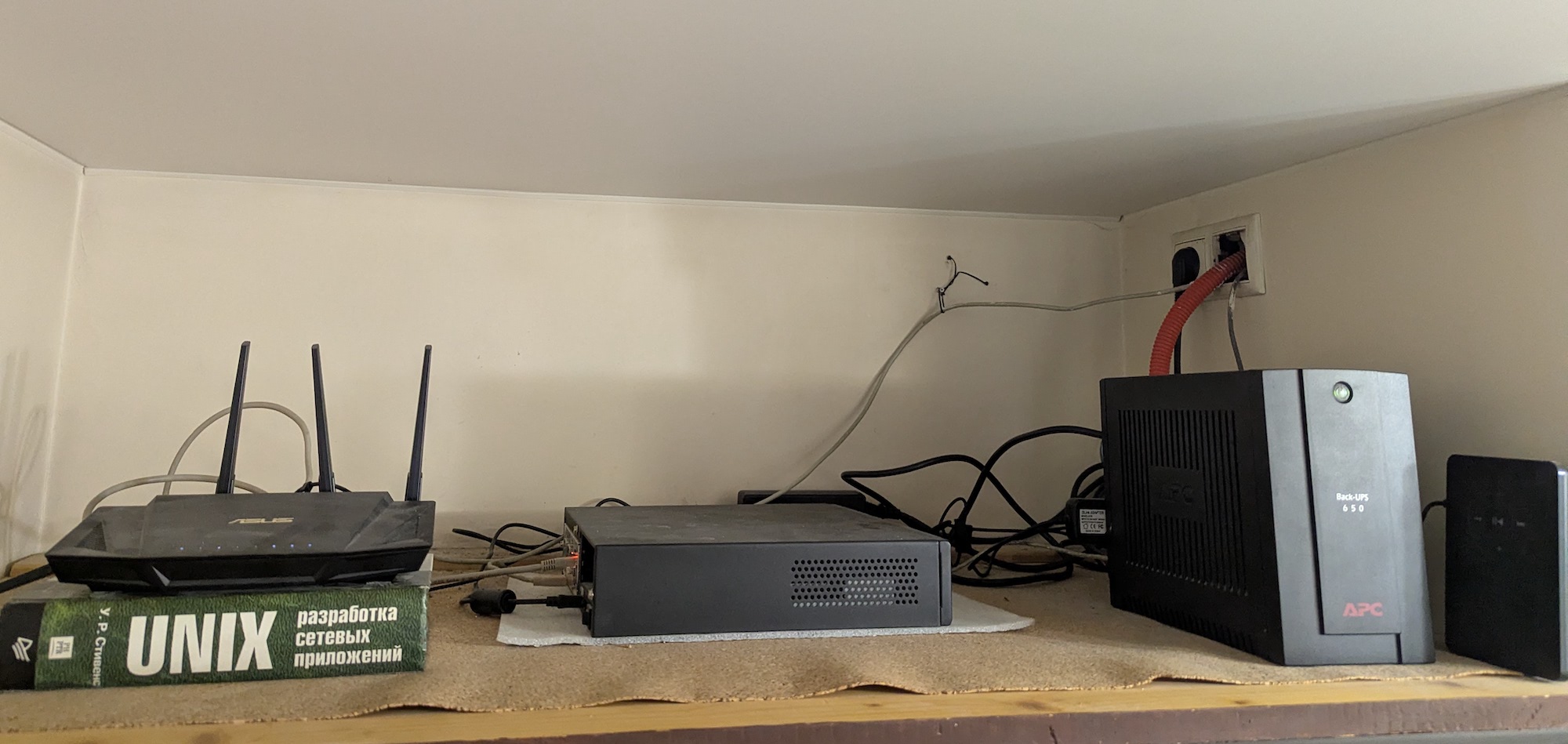
When we moved into a new house, the server finally got its home in a dedicated server half-room, which was built in an old cloakroom from pine boards. The upper half was a server space, and the lower half was a wardrobe. Plenty of space for the server, a NAS with 4 HDDs in RAID5, a UPS, and other hardware.
Atom Half-life
In 2023, we moved not just houses, but countries. It wasn’t possible to move a fragile, customised server across multiple borders. So I left the server at the old house and kept running it for two more years. At the end of 2025, it was time to shut it down completely. I erased the disk remotely and said farewell to my old friend.
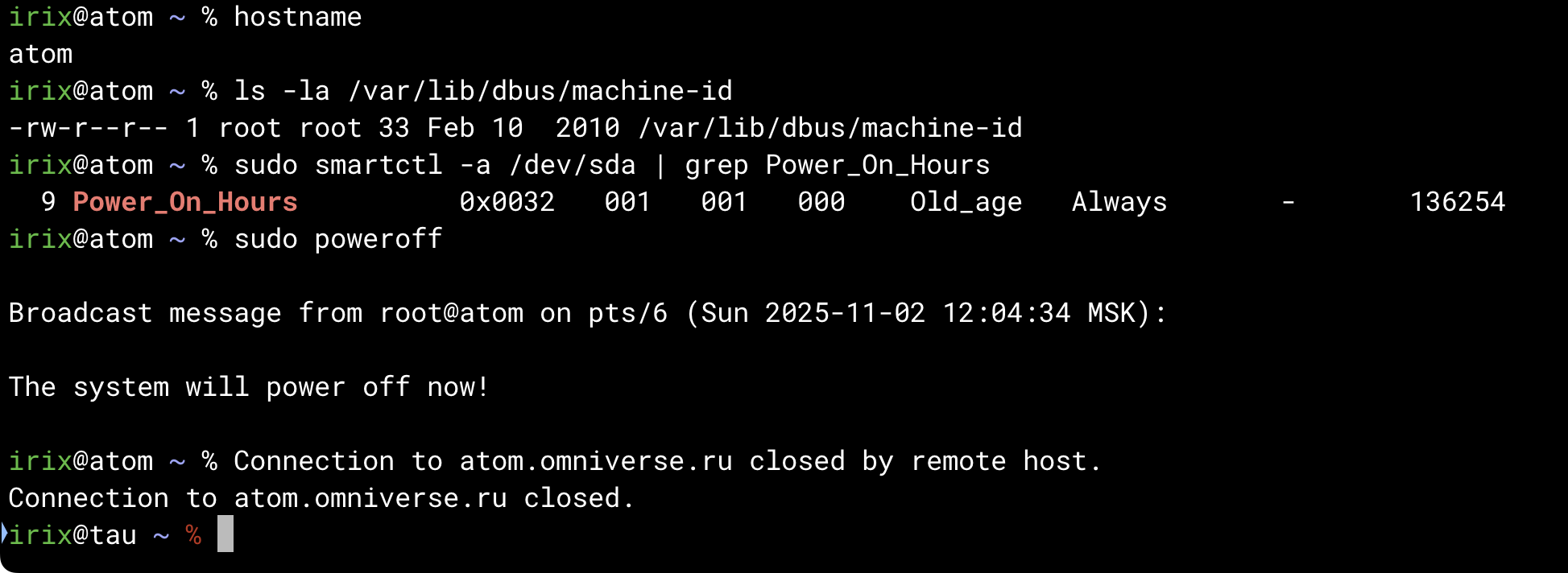
It didn’t have a huge uptime, but was rebooted monthly with kernel patches.
It didn’t have a fancy unit rack, but a customised DIY case.
It didn’t have ECC RAM, but a pair of simple modules.
It didn’t have an SSD, but a Seagate hard drive working for 15.5 years (136,254 hours).
It didn’t have an exciting operating system, but a battle-proven Debian Stable for 15 years.
It wasn’t cattle, but a pet.
It did have a name — atom.